
























Gold has rallied significantly in 2026, and the reasons behind this surge matter for anyone tracking natural resource investments. At Natural Resource Stocks, we’ve identified the key forces reshaping gold price trends this year-from central bank decisions to geopolitical tensions.
This guide breaks down exactly what’s driving the market and where opportunities lie ahead.
What’s Pushing Gold Prices Higher in 2026
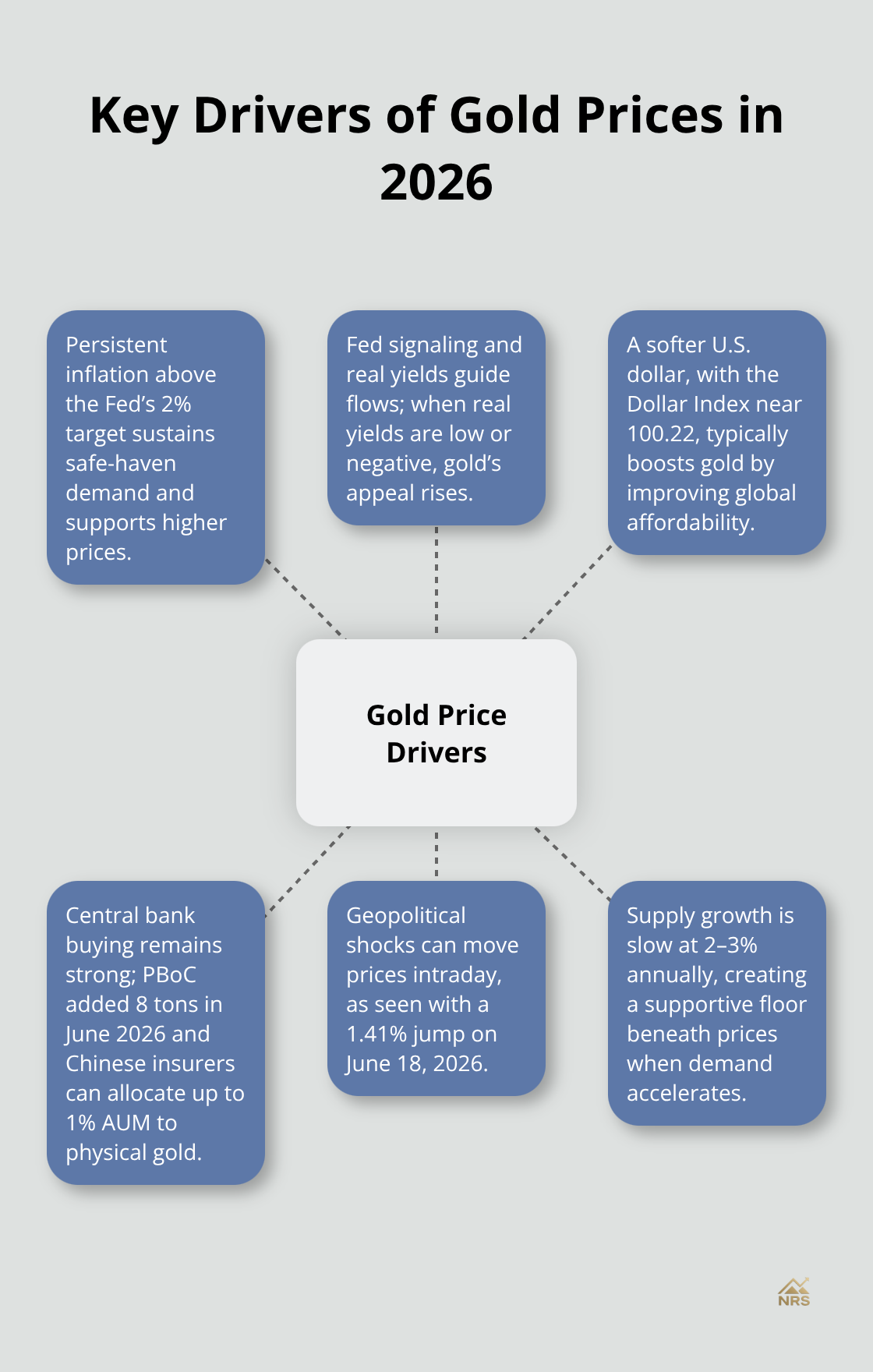
Inflation remains stubbornly above the Federal Reserve’s 2% target, and this is the single biggest driver of gold’s 2026 rally. Central banks globally face a dilemma: they must fight inflation without triggering recession, and this tension creates ideal conditions for gold to thrive. The U.S. Federal Reserve signaled growing support for rate hikes this year, with about half of FOMC members expecting hikes, yet gold has still climbed because inflation fears outweigh rate-hike concerns.
JPMorgan upgraded its 2026 gold forecast to 6,000 to 6,300 USD per ounce, up from 4,250 USD per ounce in December 2025, directly citing persistent inflation and policy uncertainty as key reasons.
Central Banks Accelerate Gold Purchases
The People’s Bank of China added 8 tons to its gold reserves in June 2026, reflecting China’s strategy to bolster gold reserves and support the renminbi as a credible reserve currency alternative. Central bank demand shows that institutional buyers view gold as essential portfolio insurance against currency debasement and inflation. Chinese insurers gained regulatory approval to allocate up to 1% of their assets under management to physical gold, representing about 200 tons at current asset levels with potential to rise to 5% later.
The Dollar’s Grip on Gold Prices
Gold trades inversely with the U.S. dollar, and this relationship is non-negotiable for understanding 2026 price movements. A stronger dollar makes gold more expensive for international buyers, suppressing demand, while a weaker dollar does the opposite. The U.S. Dollar Index stood near 100.22 on June 17-18, 2026, and any sustained weakness would provide tailwinds for gold. The practical implication is clear: if the Federal Reserve signals more rate cuts than expected, the dollar weakens and gold rallies. Conversely, hawkish Fed signals can trigger dollar strength and gold weakness.
Real Yields Drive Investor Decisions
Gold tumbled about 2% on the day the Federal Reserve signaled rate hikes, illustrating how sensitive the market is to policy shifts. For investors, this means monitoring Fed communications matters as much as tracking gold prices themselves. Real interest rates matter more than nominal ones, and when real yields turn negative or inflation outpaces bond yields, gold becomes comparatively attractive since it generates no yield. Trading Economics forecasts gold at 4,239.15 USD per ounce by the end of this quarter and 4,596.91 USD per ounce in 12 months, suggesting continued upward pressure if real yields remain suppressed and geopolitical risks persist.
The interplay between inflation, central bank action, and currency movements sets the stage for what comes next: the geopolitical tensions that have amplified safe-haven demand and reshaped investor behavior throughout 2026.
How Geopolitical Risk Reshapes Gold Demand in 2026
Safe-Haven Demand Spikes When Conflict Threatens Energy
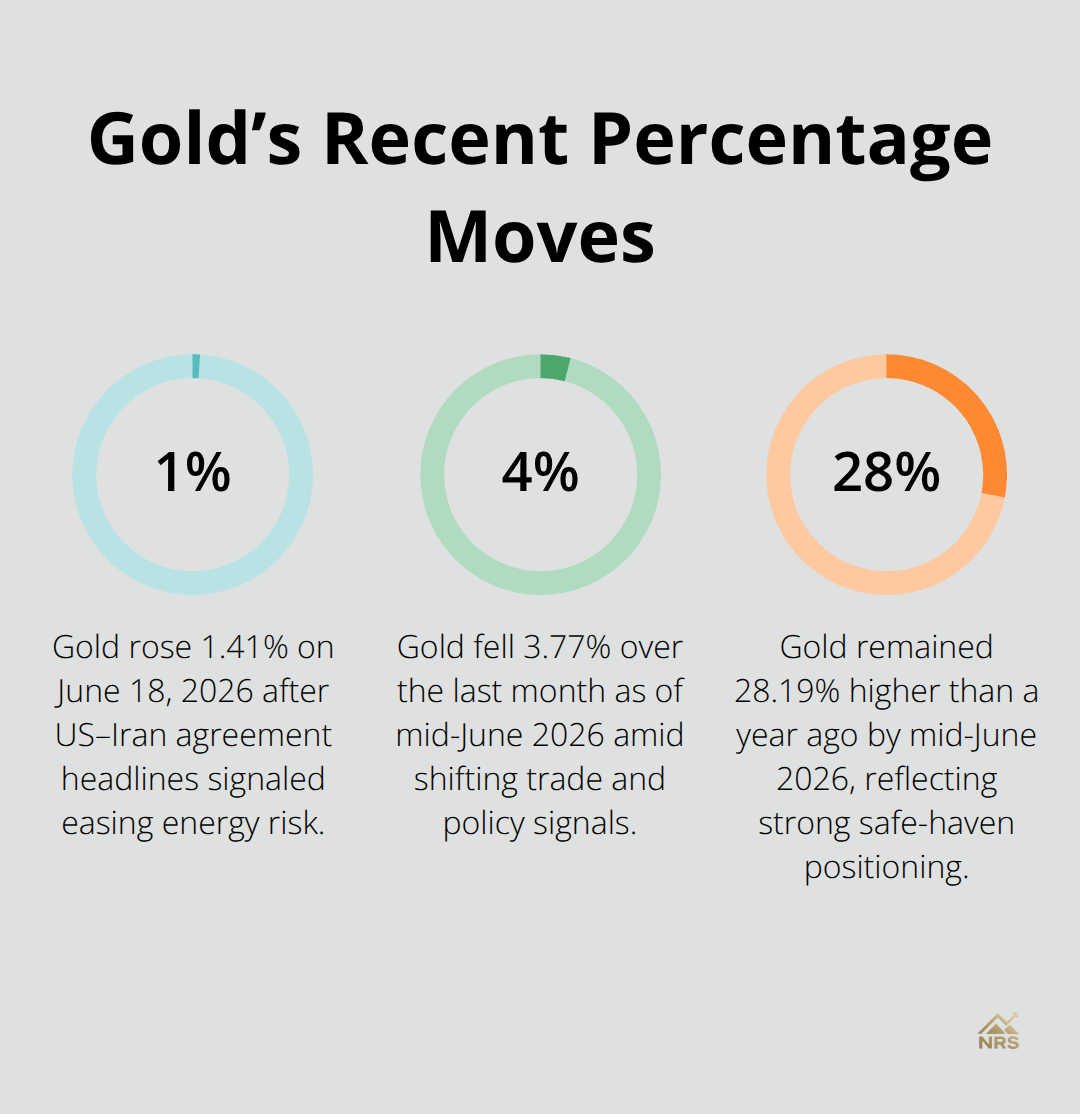
Geopolitical tension moves gold prices in real time, not as theory but as measurable market action. On June 18, 2026, gold surged 1.41% to 4,319.47 USD per ounce after reports of a US-Iran interim agreement that included swift reopening of the Strait of Hormuz and removal of sanctions on Iranian oil exports. This single-day move shows how investors treat gold as immediate portfolio insurance when geopolitical risks escalate or ease. Gold’s safe-haven premium expands when conflict threatens energy supplies or regional stability, and it contracts when headlines suggest peaceful resolution.
Monitoring geopolitical flashpoints-particularly those affecting oil production or shipping routes-provides a leading indicator for gold’s near-term direction. JPMorgan Global Research flagged Iran-Israel-U.S. tensions as adding headwinds and tail risks to energy prices and yields, influencing gold demand until a clearer resolution emerges. When energy-driven inflation persists, the Federal Reserve stays on a higher-for-longer policy path, which should theoretically suppress gold, yet geopolitical uncertainty overrides this logic and keeps investors bidding for gold as protection.
Trade Uncertainty Weakens the Dollar and Supports Gold
Trade tensions operate differently than pure geopolitical conflict. Trade uncertainty creates economic fog-companies delay capital expenditures, consumers pull back spending, and central banks face pressure to cut rates to support growth. This combination typically weakens the U.S. dollar and real yields, both favorable for gold. Over the last month as of mid-June 2026, gold fell 3.77%, but it remains 28.19% higher than a year ago, reflecting the structural shift toward safe-haven positioning despite near-term volatility.
Gold does not require a full-blown recession to perform well; it thrives during periods of policy uncertainty and elevated tail risk. De-escalation headlines ahead of holidays tend to weigh on gold, indicating that shorter-term safe-haven demand softens when geopolitical risk eases temporarily. For investors tracking natural resource stocks, this means gold’s role as portfolio ballast depends less on a single catastrophic event and more on the persistent backdrop of trade friction, sanctions regimes, and regional instability that characterize 2026.
How Institutional Investors Respond to Risk Reassessment
Investors view gold not as a speculation on crisis but as a hedge whenever institutional investors reassess their risk exposure-which happens frequently in an environment where policy signals shift and geopolitical headlines dominate the news cycle. This reassessment process creates opportunities for those who understand the relationship between headline risk and portfolio positioning. The next section examines how gold supply constraints amplify these price movements and what mining production trends reveal about the market’s structural foundations.
Why Gold Supply Can’t Keep Pace With Rising Demand
Annual mine production adds only 2-3% to the above-ground gold stock, and this slow replenishment rate sits at the heart of gold’s 2026 rally. When demand accelerates-as it has through central bank purchases and investment inflows-supply constraints become the binding factor that sustains prices. China produced roughly 370 tonnes of gold in 2025, Australia around 310 tonnes, and the United States approximately 190 tonnes, yet these outputs cannot match the surge in institutional buying.
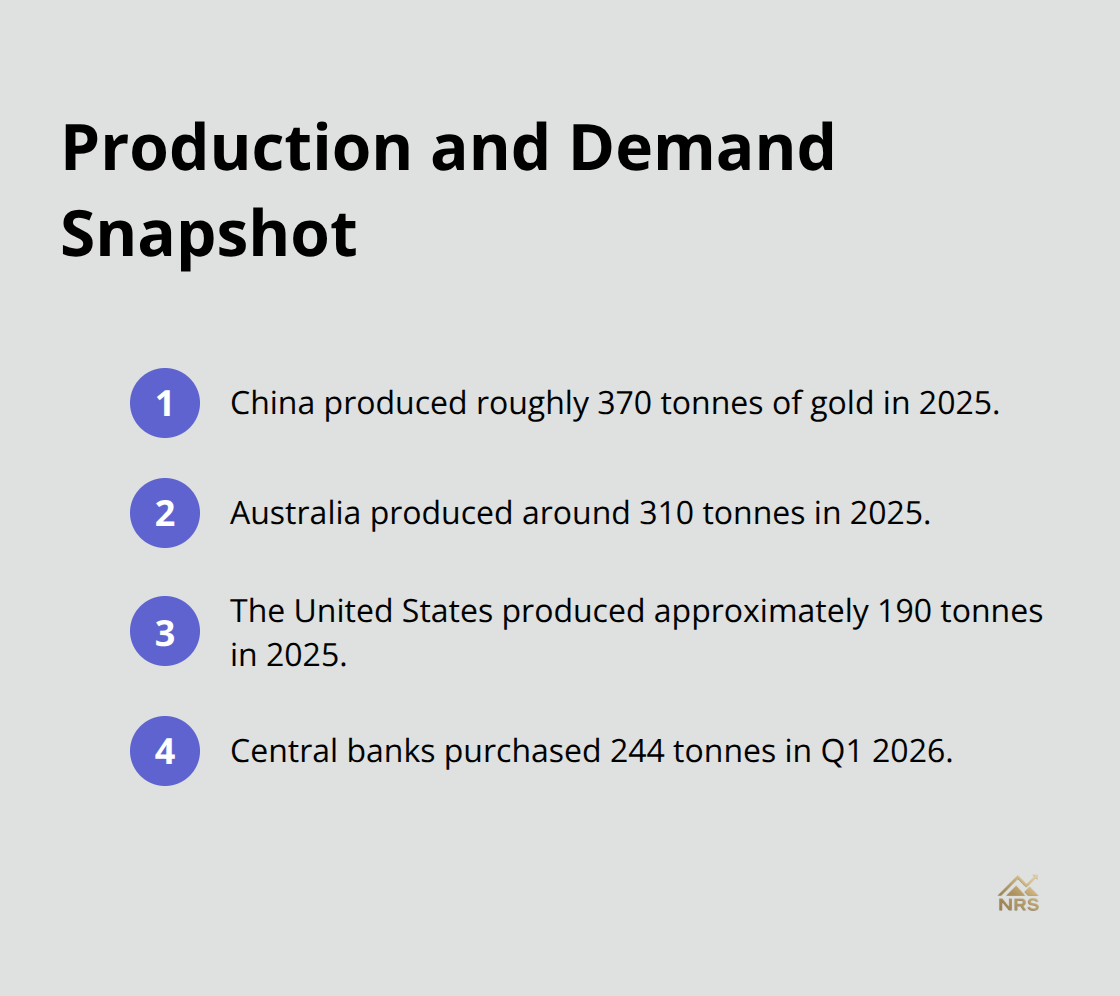
The World Gold Council reports that central banks purchased 244 tonnes in Q1 2026, nearly matching annual production from the world’s top three producers combined.
Mining Expansion Faces Years of Delays
Supply growth will remain constrained because mining expansion takes years to complete, regulatory approval stretches timelines further, and higher operating costs eat into margins that would otherwise fund new capacity. Operators cannot simply flip a switch to increase output; they must navigate permitting processes, secure financing, and construct infrastructure before a single ounce reaches the market. This structural lag means that even if prices spike, new supply cannot respond quickly enough to satisfy demand. The time lag between investment decision and first production often spans five to ten years, locking in today’s supply constraints for years ahead.
ESG Requirements Tighten the Supply Noose
Environmental, social, and governance requirements now act as a hard constraint on future supply growth, not merely as a cost consideration. Environmental compliance for water management, emissions reduction, and land restoration has raised the capital intensity of new mining projects substantially, and investors increasingly demand proof of sustainable operations before funding expansion. Major producing regions like Australia and Peru face stricter permitting standards, which delays greenfield projects and forces operators to rely on existing mine optimization rather than new capacity additions.
Tight Supply Creates a Structural Price Floor
The practical implication for investors tracking natural resource stocks is straightforward: tight supply combined with persistent institutional demand creates a structural floor under gold prices, even if near-term geopolitical headlines fade or inflation moderates temporarily. Supply constraints mean that price weakness typically attracts buyers rather than triggering capitulation, fundamentally different from markets where oversupply can trigger collapse. This dynamic protects investors from the kind of sustained downturns that plague commodities with elastic supply responses.
Final Thoughts
Gold’s 2026 rally reflects three converging forces that we at Natural Resource Stocks have tracked throughout the year: inflation persistence, central bank reserve building, and geopolitical uncertainty. JPMorgan’s upgraded forecast to 6,000–6,300 USD per ounce by year-end reflects this structural shift, and the data supports sustained strength ahead. The People’s Bank of China accelerated purchases, while regulatory approval for Chinese insurers to allocate up to 1% of assets to physical gold signals institutional conviction that gold price trends 2026 will remain supported by demand that outpaces supply growth.
The outlook hinges on three variables that will shape gold’s path forward. First, whether the Federal Reserve cuts rates as markets increasingly expect, which would weaken the dollar and lift gold. Second, whether geopolitical tensions ease or escalate, directly affecting safe-haven demand. Third, whether inflation moderates enough to ease central bank concerns without triggering recession. Trading Economics forecasts gold at 4,596.91 USD per ounce in twelve months, implying continued upward momentum if these conditions hold.
For investors seeking exposure to gold price movements, direct ownership through physical bullion or ETFs like GLD remains straightforward, though storage and custody require attention. Gold mining stocks offer leveraged exposure to gold prices while providing dividend potential that bullion itself cannot match. Natural Resource Stocks provides expert analysis on precious metals and mining equities, helping investors navigate macroeconomic drivers and geopolitical impacts that shape resource prices.